City Light Show Project: Shenzhen Landmark Laser Water Show

City Light Show Project: Shenzhen Landmark Laser Water Show

Summary

City light show project: Shenzhen landmark water screen projection and laser show with IP65 fixtures, 20,000lm projectors and timecode sync. Get a free design.


A city light show project in a first-tier city like Shenzhen has one job: turn a busy waterfront into a repeatable night-time destination without failing in wind, rain or peak-hour crowds. Shenzhen's city-core landmark show called for exactly that — a stable water screen projection, long-throw landmark lasers reaching across the skyline, and a single clock keeping every subsystem in step.
Project Background & Lighting Challenges

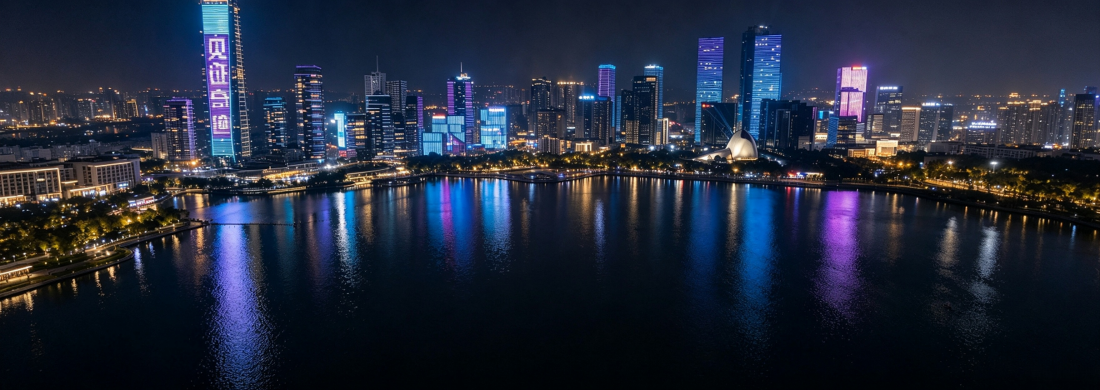
The site sits in Shenzhen's core waterfront district, framed by high-rise towers, an open lake and a public promenade that stays busy after dark. The brief was to build a signature landmark light show that reads from the far shore, survives coastal humidity and heavy weekend footfall, and can be run by a small crew every evening. Four constraints shaped the design.

1、Unstable projection medium. A water screen is not a wall. Wind, nozzle pressure and droplet density shift from minute to minute, stretching and softening the image. Content had to be tuned to a moving, semi-transparent surface rather than a fixed facade.

2、Long-distance landmark laser work. Beams had to travel hundreds of metres from lakeside rigs to tower tops and the night sky, holding tight divergence and clean colour while avoiding aircraft corridors and residential windows.

3、Cross-system timing. Laser, projection, fountain actuators, audio and facade fixtures needed frame-level timecode sync. Any drift broke the illusion and, more seriously, risked unsafe beam placement during scene changes.

4、Live-site construction and utilities. Installation windows were limited to night shifts in a working city core. Power distribution, long signal runs, grounding and water-side access had to be engineered before a single fixture was mounted.

5、Daily operation. Salt-laden humidity, rain and nightly run time meant corrosion, thermal stress and lamp-hour management would decide the real cost of ownership.
Lighting Design & Overall Solution

The concept was to build one show from three visual layers rather than pile effects onto the water. The system pairs 20 outdoor waterproof 60W lasers with three 20,000-lumen 3LCD projectors, all driven by a single timecode master. Every device was chosen for outdoor duty, service access and protocol compatibility first, brightness second.

Lighting Zoning & Layering

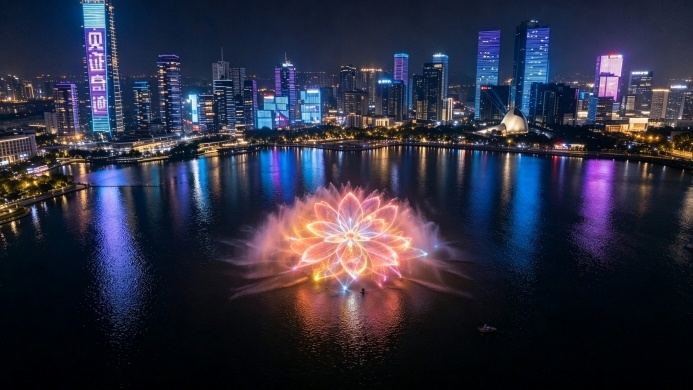
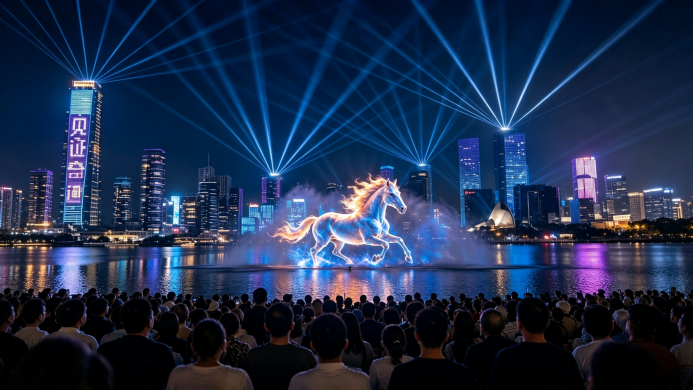
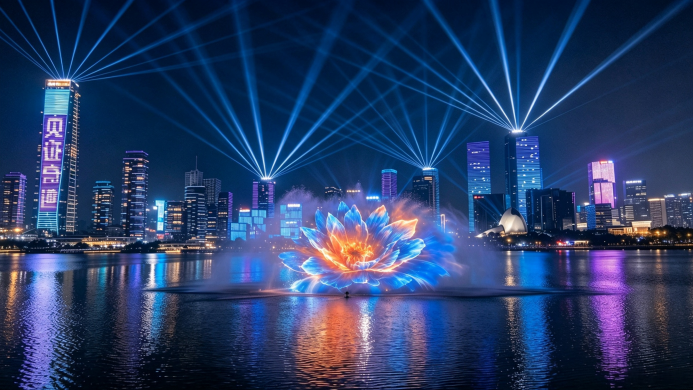
The water screen zone carries the narrative. Three projectors form the projection show surface, with content aspect ratio and loop length matched to the droplet field — floral and equine imagery reads cleanly even as the screen breathes. The skyline zone uses the 60W lasers from four rig points for aerial beams, fan sweeps and tower-top hits; beam angles were set to the viewing distance of the far promenade, not to close-range spectacle. A shoreline zone of lower-intensity fixtures shapes the walkway and keeps foreground detail from competing with the main show.

Fixture Selection & Control System

Twenty 60W waterproof laser lights provide the beam layer: sealed IP65 housings, high-speed scanners, and ILDA / DMX512 / Art-Net compatibility inside a Pangolin BEYOND workflow. Three 20,000-lumen outdoor projectors deliver WUXGA 1920×1200 imagery with a rated source life of 20,000–30,000 hours, housed in thermostatic cabinets for long outdoor runs.

Results & Project Value

The show now operates as a repeatable night-time anchor for the district. For the owner, it extends evening dwell time along the waterfront and gives visitors a reason to stay, film and return. For the EPC contractor and the landscape design team, the value is less visible but more important: a system that commissions on schedule, hits its visual brief on a moving water medium, and runs nightly with a small operating crew. In tender terms, it is a reference city-core project that de-risks the next one.


Technical Edge, Stability, Protection & O&M

Three engineering decisions carry the long-term performance of this cultural tourism night tour lighting system.

1、Protection: IP65 sealing on all water-side fixtures, salt-spray tested housings and an operating range of -20°C to +45°C. Cable entries, breathers and connectors were specified for the site's humidity, not just the datasheet.

2、Compliance and laser safety: FDA / CDRH Class IV laser safety documentation, CE, RoHS, FCC and an ISO-based quality system, backed by waterproof test reports and salt-spray test reports, and supported by beam shutters, scan-fail interlocks, controlled audience zones and permit-ready files for local approval.

3、Serviceability: Modular laser and projector assemblies, front-access maintenance paths, remote diagnostics and a documented spare-parts plan. Scene files and timecode are version-controlled, so a content change never becomes a site visit.

Standardising on outdoor-rated hardware also cut energy use versus a conventional fixture-heavy rig, lowering the running cost of every performance without reducing impact.
FAQ — City Light Show Projects
1. What drives the budget of a city light show project?
Site scale, viewing distance, number of show surfaces, and how many systems must sync. A water screen projection show adds nozzle and content costs; long-throw landmark laser beams drive power and safety planning. Share a site plan and target effects for a realistic configuration.
2. How do you keep a water screen projection sharp outdoors?
By matching projector brightness and lens throw to the droplet field, keeping content high-contrast and short-loop, and tuning on site at the actual nozzle pressure. A water screen will always move; good design treats that as a variable rather than a defect.
3. Are IP65 outdoor lighting fixtures enough for a coastal city?
IP65 is the right baseline for rain and dust, but coastal sites also need corrosion-tested housings, correct cable glands and a maintenance schedule. For permanently wet zones, ask about sealed options with the right protection rating and salt-spray test data.
4. How do you sync lasers, projection, fountains and audio?
A single timecode master distributes LTC/MTC to every controller over redundant signal paths. Scene changes, beam on/off and fountain cues are locked to the same clock, which is essential for both visual quality and laser safety.
5. Can show content be customised for a tourism night tour?
Yes. Content is produced around the site's architecture, water geometry and cultural theme, then programmed into the timecode timeline so laser, projection and music stay aligned as the show evolves.

Planning a city light show project of your own?

We can help with a free lighting concept, fixture schedule and budget range — from water screen projection and landmark laser design to full custom city lighting solutions and how to work with us. If you are an EPC contractor, landscape designer or destination operator, send your site photos and viewing targets and our team will respond with a tailored proposal.

Get a Free Lighting Design & Quote