Ancient Building Nightscape Lighting: Korea Case Study

Ancient Building Nightscape Lighting: Korea Case Study

Summary

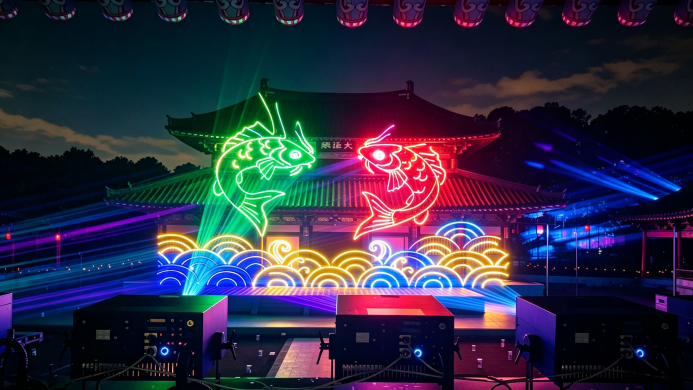
In Busan, a protected heritage landmark became a night-tour attraction. Ten 40W waterproof laser lights drew the architecture, koi and waves; projection added golden halos; 22 wash lights lit the gardens. Nothing was fixed to the building — a safe, repeatable nightly show.
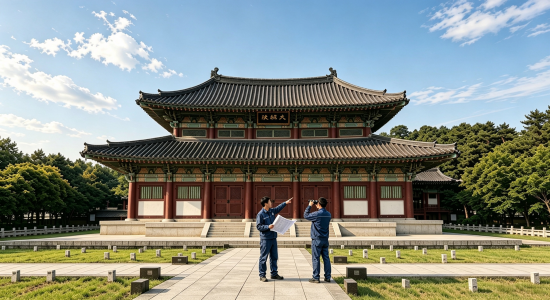
A nationally protected heritage landmark in Busan nearly disappeared after sunset, even though the city needed it to anchor its night tourism route. This ancient building scenic area night tour lighting project had one goal: turn a landmark facade into a safe, repeatable evening attraction without touching the heritage fabric. For general contractors, lighting designers and scenic area operators, the brief is familiar—spectacle on one side, approvals and conservation on the other. Here is how ten waterproof Outdoor Landscape Laser Lights, five projectors and twenty-two wash fixtures were specified, permitted and installed.


1. Project Background & Heritage Lighting Challenges

The building is a nationally designated heritage landmark and one of Busan's most recognizable traditional structures. As a core scenic area project, it was expected to extend visitor dwell time and give the surrounding plaza a reason to stay open after dark. The client—a scenic area operator working with the local heritage authority—wanted a landmark nightscape that read clearly from the approach road, yet stayed restrained up close.


Three constraints shaped every decision:

1、Approval and compliance. Any external rig had to pass heritage review, light-spill limits and laser-product regulation. For the show lasers, documentation had to cover FDA laser product reporting and 21 CFR 1040.11(c) for demonstration laser products, alongside CE and local electrical sign-off.
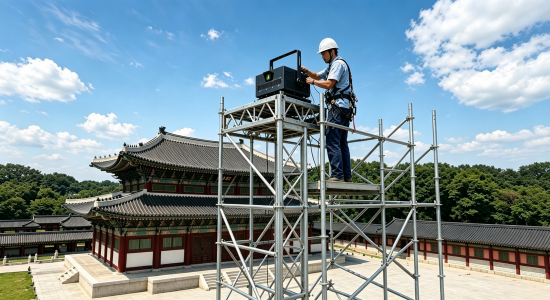
2、Heritage fabric protection. No drilling, clamping or heat on painted timber or the roof structure. Fixtures were kept off the building skin on free-standing and garden-mounted positions.
3、On-site installation. A coastal site meant salt-laden humidity and typhoon wind loads; a live public plaza meant night-only work windows and fully concealed cabling.

2. Lighting Design Concept & Overall Solution

Design-led, not equipment-led: no LED strips were used — laser lights and projection created the walls, motifs and golden halos; wash lights coloured the gardens. DarkTone supplied the stage laser & lighting package and integrated the projection units.

Lighting zoning and layering
Zone A — Building walls and outline. Ten 40W outdoor laser lights projected the walls, eaves and columns with cool-to-warm laser outlining — nothing fixed to the fabric.
Zone B — Koi and wave motifs. The same laser lights drew koi and wave patterns on the facade, tying the show to local water folklore; content stayed reprogrammable.
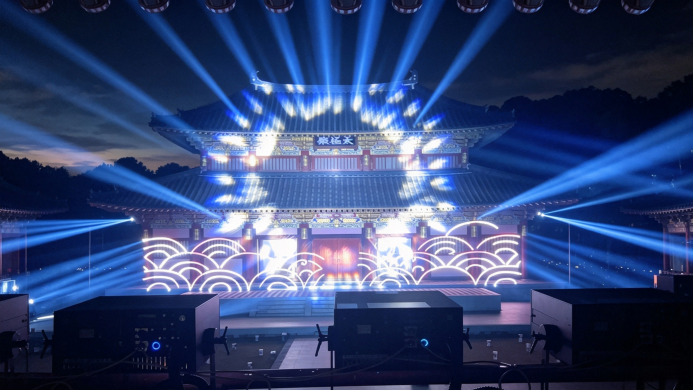
Zone C — Golden halo effect. The golden rings framing the hall came from laser lights and projectors working together: lasers drew the outlines, five 15,000-lumen projectors filled them with warm light. This projection show ran on a time-coded loop.
Zone D — Garden and landscape. Twenty-two IP65 wash/dye lights coloured the scenic area's gardens and approach route only, keeping spill off the heritage wall.

Fixture selection and control system

Ten 40W waterproof laser lights carried the outlining and laser-drawn koi and wave motifs — no surface-mounted strips. Their IP65 housings and DMX/ILDA control switched from static lines to full beam choreography; the outdoor IP65 lighting fixtures ran nightly, not for one-off events. Five 15,000-lumen projectors worked with the laser lights to create the golden halos, while twenty-two wash/dye lights handled the gardens.

All devices sat on a DMX512 / Art-Net network with a time-coded show server. Zone dimming, an emergency stop and beam-angle limits were written into the control file, easing the permit review.


3. Results & Project Value

The landmark now runs a nightly show that closes the loop between the scenic area and the city's evening economy. Evening dwell time increased, the plaza stayed active after the daytime ticket window, and the facade became a recognizable backdrop for visitor photography—exactly the repeatable attraction the operator asked for.

For the project team, the value was in delivery as much as in the picture: approvals were secured without a redesign cycle, the heritage authority recorded no damage to the building fabric, and commissioning was completed within the contracted night-work windows. A documented cultural tourism night tour lighting scheme also gave the operator a maintenance and content-update path rather than a one-off installation.

4. Technical Advantages, Stability, Protection & O&M

Coastal exposure drove the specification. Sealed IP65 enclosures, corrosion-resistant finishes and salt-spray-tested hardware were used throughout the outdoor stage laser & lighting package; projectors and wash fixtures were rated for continuous damp-condition duty. CE, ISO and FDA documentation was assembled into one permit-ready file, so the compliance review could proceed on evidence rather than assurances.

Precise beam control cut spill onto neighbouring residences and the heritage roof, which directly eased the approval conversation. On the operations side, the system runs a nightly self-check, supports remote fault diagnosis and uses modular parts that can be swapped without dismantling a rig. Compared with a conventional floodlight installation, the LED-based scheme cuts energy use substantially while keeping the same visual impact—an argument that carries weight with operators watching nightly running costs.
5. FAQ — Common Questions from Contractors & Designers
Q1. Why specify outdoor IP65 lighting fixtures for a heritage night tour project?
Because IP65 units survive rain, humidity and salt without adding maintenance visits to a protected site. In this project the sealed housings also allowed fixtures to sit in the garden and on the plaza rather than being attached to the building, which was a condition of the heritage approval.
Q2. Does laser outlining risk damaging a protected facade?
No, when it is designed as non-contact. The outlines were projected from ground positions with beam paths set to stop short of fragile painted surfaces, and output levels were limited during the review process. Nothing was fixed to the heritage fabric itself.
Q3. How are fish and wave patterns drawn on a protected building?
With laser lights, not surface-mounted strips. Ten 40W outdoor units projected the koi and wave motifs from ground positions and were geometrically aligned during commissioning to follow the elevation. Laser lights and the projection show worked together on the golden halo, so imagery stayed sharp without any fixture touching the heritage wall.
Q4. What approvals does a core scenic area project like this typically need?
Expect heritage consent, local light-spill and electrical review, and laser-product documentation for the show equipment. Having CE, ISO and FDA files prepared at tender stage—as was done here—removed the usual back-and-forth and kept the programme intact.
Q5. Can a supplier provide a free lighting design and quotation for cultural tourism night tour lighting?
Yes. DarkTone works with engineering contractors, designers and scenic area operators from concept to commissioning, including a custom architectural lighting solution, equipment schedules and budget pricing before any commitment.

Plan your own landmark nightscape

If you are bidding on a heritage or scenic area lighting project, we can help you build a permit-ready scheme—zoning, fixture schedule, control design and a free concept layout. Explore how to work with DarkTone, or send your drawings and brief through our Contact Us page for a free lighting design and project quotation.